
Itching, bleeding and crusting are the symptoms most likely to make a patient pay attention to a specific mole. They are also the symptoms most likely to be searched on the NHS website at 11pm before booking a GP appointment the following morning. The good news is that all three have a benign explanation in the great majority of cases; the less reassuring news is that all three appear on the NICE two-week-wait criteria for suspected skin cancer, so the consultant threshold is genuinely lower for these symptoms than for static appearance changes.[1]
What patients want is a clear answer to a simple question: when does this symptom warrant a consultant, and when can I reasonably wait? The answer depends on duration, recurrence, and whether other features cluster with it. This guide breaks each of the three symptoms down with a practical decision rule for each.
Written and medically reviewed by a GMC-registered consultant dermatologist who sees these symptoms daily and runs the dermatoscopic assessment that translates them into clinical certainty.
Why these three symptoms in particular
All three symptoms (itching, bleeding, crusting) appear on the NICE NG12 guideline as features that should prompt a two-week-wait referral when present in a pigmented lesion. They share a common biological basis: each suggests the surface or surrounding tissue of the mole is no longer behaving as inert background skin. That can happen for benign reasons (eczema next to a mole, physical trauma, irritated mole) or concerning reasons (atypical naevus, melanoma, basal or squamous cell carcinoma).
Studies of self-detected melanoma consistently identify these three among the most commonly reported symptoms, alongside rapid change.[2] The implication: when a patient notices any of them and does nothing for months, they're often the early warning that gets ignored. The implication for clinics: when a patient notices any of them and books a consultation, taking the symptom seriously and not dismissing it is the right default.
The framework below ranks each symptom by how common a benign explanation is, what the threshold is for booking, and what the consultant will do. Use it to triage your own concern; book if any of the thresholds apply.
Itching: when a mole 'just itches'
Itching is the most commonly reported and most often benign of the three symptoms. Healthy moles do not have nerve endings that produce sensation, but the surrounding skin does, and an itch perceived 'on a mole' is usually an itch on the skin around it. Common benign causes include dry skin, contact with rough fabric, friction from clothing, sweat, mild eczema affecting the surrounding area, and seasonal allergens.
The pattern that warrants a consultant is persistent itching, defined as itching that recurs every day or most days for two weeks or more, particularly if it's localised to that specific mole rather than a wider area, and particularly if combined with any other change in the mole. Itching in a mole that's also growing, becoming asymmetric, or developing multiple colours is meaningfully more concerning than itching alone.
Practical rule. Itching that resolves with a moisturiser within a week, or that comes and goes with weather/clothing, can usually be ignored. Itching that persists despite simple measures and continues for two weeks should be assessed. Itching combined with any other ABCDE feature should be assessed within a week.
Bleeding: trauma versus spontaneous
Bleeding from a mole has a binary clinical interpretation: was it caused by physical trauma, or did it happen on its own? Trauma-bleeding is what happens when a mole is nicked while shaving, scratched, or caught in clothing. It bleeds briefly, scabs cleanly within a day or two, and heals without recurrence. This is benign and requires no action beyond keeping the area clean. Spontaneous bleeding is bleeding without obvious cause, often noticed on bedsheets or undergarments overnight, frequently recurrent over weeks. This warrants a consultant within a week.
The reason spontaneous bleeding matters: it suggests the mole's surface integrity has been compromised at a cellular level, which is more characteristic of invasive melanoma and non-melanoma skin cancers than of benign naevi. Pedunculated moles (raised on a stalk) can bleed from minor friction without it being clinically significant; flat or compound moles that bleed without trauma are more concerning and deserve assessment.[1]
Distinguish between the two by asking yourself: can I identify what caused the bleeding? If yes, and the bleeding was a one-off, it's almost certainly trauma. If no, or if the bleeding has happened more than once across weeks, treat it as spontaneous and book.
Crusting: the silent warning
Crusting is the formation of a thin scab on the surface of a mole, often without any preceding bleeding the patient noticed. It is the most often missed of the three symptoms because patients rationalise it as 'I must have caught it' even when there's no specific incident to point to. The pattern that matters is repeated crusting: a crust forms, comes off (often during a shower or while drying with a towel), and reforms within a week or two.
Repeated crusting suggests the mole's surface keratinisation is no longer normal, which can occur in several contexts: an inflamed seborrhoeic keratosis, an atypical naevus undergoing change, an actinic keratosis (sun-damage lesion that can progress to squamous cell carcinoma), or invasive non-melanoma skin cancer. None of these is dermatoscopically obvious to a non-specialist; all of them benefit from a consultant assessment.
Practical rule. A single episode of crusting that resolves cleanly is often nothing. Crusting that recurs more than once across a few weeks, or crusting on a lesion that's also changed in size, colour or shape, warrants a consultation within a week. Don't accept the 'I must have caught it' narrative the second time it happens.
What the consultant actually does at the appointment
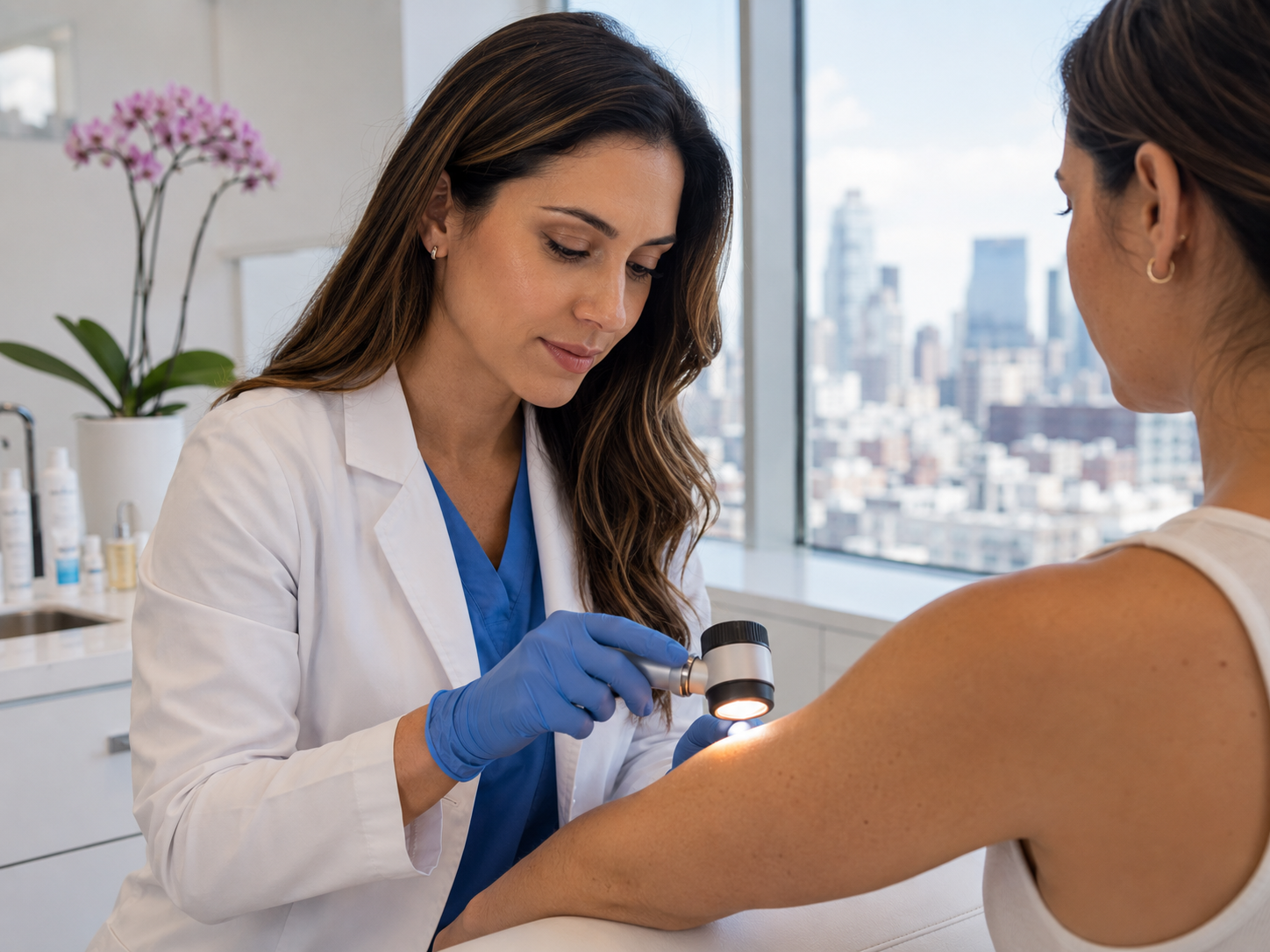
A consultation for any of these three symptoms follows the same structure. The consultant takes a focused history (when did the symptom start, how often does it recur, has anything else changed about the mole), examines the lesion with the naked eye, then performs polarised dermatoscopy (a high-magnification examination that reveals features invisible to the naked eye).
Based on findings, one of three outcomes is typical. Most commonly: the lesion is benign, the symptom has a benign explanation, and you receive reassurance plus written confirmation. A smaller proportion: the lesion is dermatoscopically borderline, and the consultant recommends either re-examination at 3-6 months or excision with histology depending on how concerning the features are. The smallest proportion: the lesion is dermatoscopically suspicious for skin cancer, and same-day excision with histology is recommended.
Whichever outcome, you leave the appointment with a clear plan rather than ambiguity. Histology results return within 7-10 working days, and the consultant calls you with the result on the day it's received. The £250 mole check fee covers the assessment in full; same-day excision adds £325-475 depending on lab fee. Self-pay only, no insurance pre-authorisation.
Decision summary by symptom
Itching: book if the itch persists daily for 2+ weeks, is localised to the mole rather than a wider area, or combines with any other ABCDE feature. Try moisturiser and removing potential irritants first if the itch is recent and isolated; the cost of waiting two weeks for a likely-benign isolated itch is small.
Bleeding: book within a week if the bleeding was spontaneous (no identifiable cause), or if a single trauma-bleed has recurred more than once. Single trauma-bleeds that heal cleanly without recurrence don't need an appointment.
Crusting: book within a week if the crust has reformed at least twice, or if the crusting accompanies any other change. A one-off crust that heals cleanly is usually nothing.
Across all three: any combination of two or more symptoms in the same lesion, regardless of duration, warrants a consultation within a week. Combinations of symptoms have a meaningfully higher positive predictive value than any single symptom alone.
What not to do
Three things to avoid while you're deciding whether to book. Don't pick or scratch the mole. Repeatedly disturbing a lesion delays healing of any minor breakdown, makes any underlying lesion harder to dermatoscope cleanly, and risks introducing infection. If a mole is itching, use a cool flannel rather than a fingernail.
Don't apply over-the-counter wart, mole or skin-tag removal products. These contain salicylic acid, trichloroacetic acid or other caustic agents designed for non-pigmented lesions. Applied to a mole they damage the surface, distort the dermatoscopic appearance, and can mask early melanoma changes. They also cannot 'remove' a true mole; they only damage the surface.
Don't wait for a bleeding mole to 'settle' across weeks. Spontaneous bleeding in a mole does not resolve on its own; it recurs cyclically, often becomes worse, and the longer it's left the more advanced any underlying lesion may be by the time it's diagnosed. The cost of an unnecessary consultation is one consultation; the cost of waiting too long with a real malignancy is incomparably higher.
Common questions
Frequently asked
References
Sources cited
- NICE guideline NG12. Suspected cancer: recognition and referral, including skin cancer pathway. Updated 2023. View source
- Brady MS, Oliveria SA, Christos PJ, et al. Patterns of detection in patients with cutaneous melanoma. Cancer. 2000;89(2):342-347. View source
- Argenziano G, Ferrara G, Francione S, et al. Dermoscopy: the ultimate tool for melanoma diagnosis. Semin Cutan Med Surg. 2009;28(3):142-148. View source
- Vestergaard ME, Macaskill P, Holt PE, Menzies SW. Dermoscopy compared with naked eye examination for the diagnosis of primary melanoma: a meta-analysis. Br J Dermatol. 2008;159(3):669-676. View source
- British Association of Dermatologists. Skin cancer pathway and patient information. View source