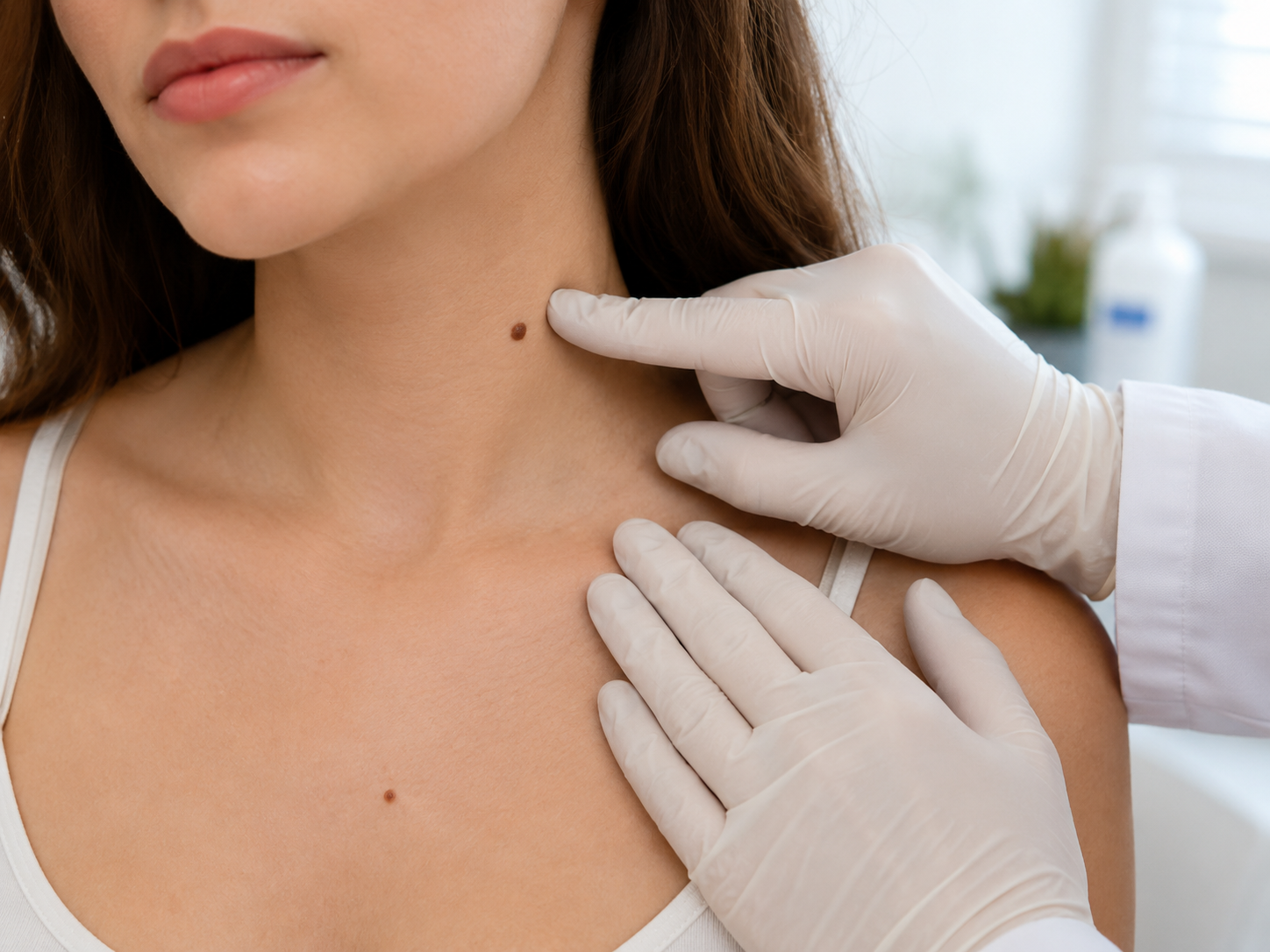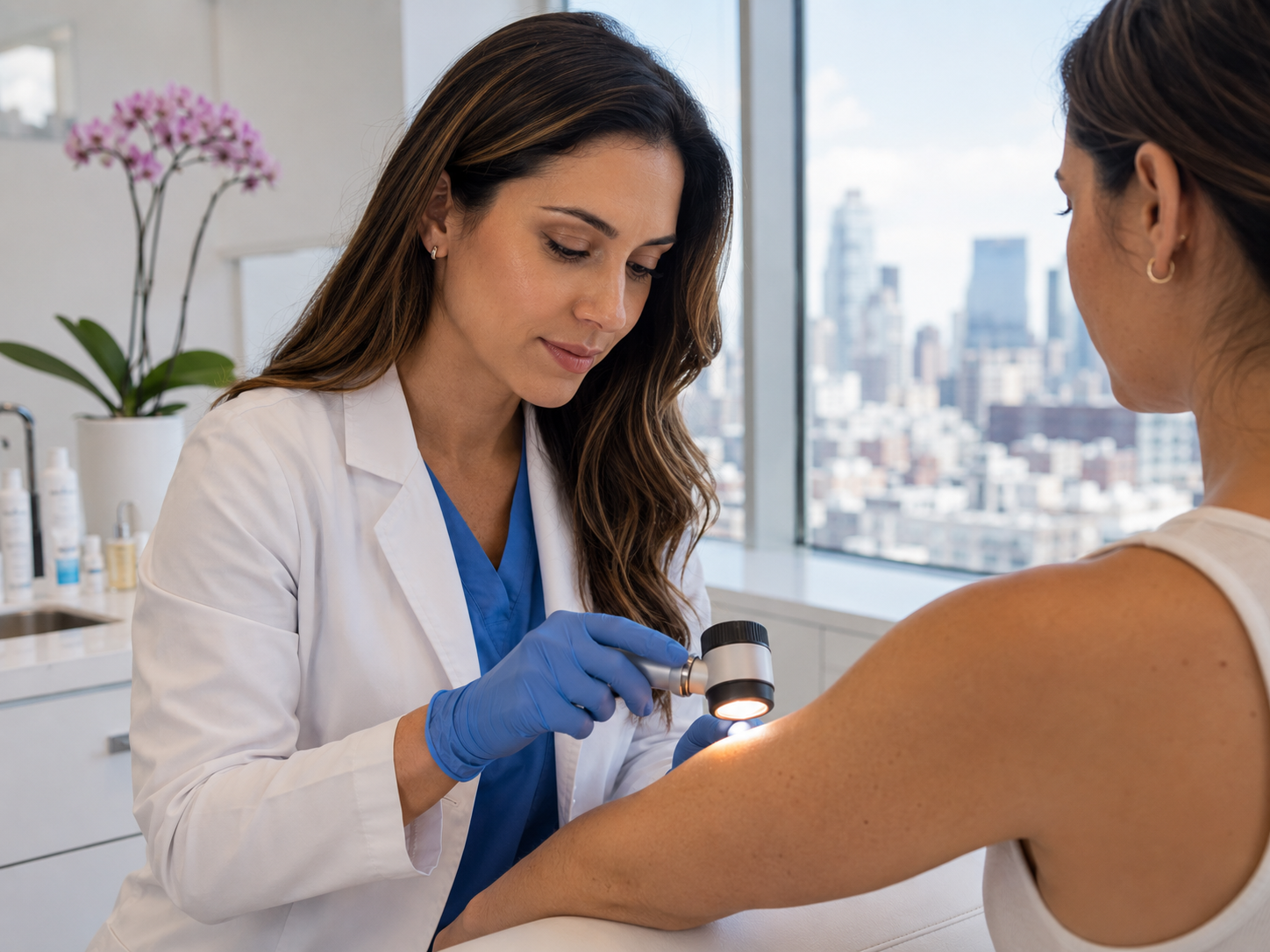

Patients regularly book a mole check for something that turns out, on dermatoscopy, to be a freckle, an age spot, or a skin tag rather than a true mole. The opposite happens too: patients dismiss something as 'just a freckle' when it's actually a small dysplastic naevus that warrants monitoring. The clinical decisions are different for each, and so is the urgency.
The four lesions in this guide (acquired melanocytic naevus, ephelide / freckle, solar lentigo / age spot, and acrochordon / skin tag) account for the great majority of small benign skin lesions adults notice. Each has a distinct biology, a distinct typical appearance, and a distinct relationship to skin cancer risk. None on its own is dangerous; misidentifying one for another can be.
This guide walks through what defines each, the visual features that distinguish them at home, and the threshold at which each warrants a consultant. Written by a GMC-registered consultant plastic surgeon who removes hundreds of these lesions each year (and reassures many more).
Moles (acquired melanocytic naevi)
A mole is a cluster of melanocytes, the cells that produce melanin pigment. Most adult moles are 'acquired melanocytic naevi', meaning they appeared during childhood, adolescence or young adulthood rather than being present at birth. They sit either at the dermo-epidermal junction (junctional naevi), spanning that junction (compound naevi), or wholly within the dermis (intradermal naevi). The depth determines the typical appearance.
Visually: usually 2-6mm, round or oval, with a clean defined border and a single shade of brown. Compound naevi are the most common adult type and are slightly raised. Intradermal naevi (typical of middle age and beyond) are often dome-shaped and pale brown to skin-coloured. Junctional naevi (more common in childhood and young adulthood) are flat and uniformly brown.
Significance: most moles are entirely benign and stable across decades. The minority that warrant attention are atypical or dysplastic naevi (irregular border, multiple colours, larger than 6mm), which are a risk marker for melanoma rather than melanoma themselves. ABCDE applies to all moles; any mole showing change deserves a consultant's eye regardless of how 'typical' it looked before.
Freckles (ephelides)
Freckles, technically called ephelides, are small flat tan or light brown spots that appear on sun-exposed skin. They are not melanocyte clusters; they're small areas where existing melanocytes produce more melanin in response to UV exposure. Genetics play a strong role: freckles are most common in people with fair skin and red or blond hair, particularly those with the MC1R gene variant.[1]
Visually: very small (1-3mm), flat, light tan to medium brown, almost always on sun-exposed sites (face, shoulders, arms, upper back). They typically appear in childhood, darken with summer sun, and fade in winter. Freckled adults often have dozens to hundreds spread across exposed skin. Each individual freckle is uniformly coloured with a soft, sometimes ill-defined edge.
Significance: freckles themselves are entirely harmless and do not progress to skin cancer. However, the freckled phenotype is a marker of UV sensitivity and indirectly of melanoma risk: people who freckle easily generally have skin types I-II (Fitzpatrick), which carry meaningfully higher lifetime melanoma risk. So freckles are not the lesion to remove or worry about; they're a hint that the rest of your moles deserve closer surveillance.
Age spots (solar lentigines)
Age spots, technically solar lentigines (singular: lentigo), are flat brown patches that develop on chronically sun-exposed skin in middle age and beyond. They differ from freckles in three ways: they're larger (typically 5-20mm vs 1-3mm), they're persistent year-round rather than fading in winter, and they reflect cumulative UV-driven melanocyte change rather than seasonal melanin production.
Visually: 5-20mm, flat, well-circumscribed, uniformly tan to medium brown. Most common on the face, dorsum of the hands, forearms, and upper chest. Patients in their 50s and 60s typically have several; older patients can have many. The colour is uniform within each lesion, the border is clean, and the surrounding skin often shows other signs of chronic photodamage (uneven pigmentation, fine wrinkles, telangiectasia).
Significance: solar lentigines are benign in themselves and do not progress to skin cancer. However, they share their preferred site (chronically sun-exposed skin) with two important melanoma look-alikes: lentigo maligna (a slow-growing form of melanoma in situ that can present as an irregularly pigmented patch among solar lentigines) and pigmented actinic keratosis. After 60, any new pigmented patch on sun-exposed skin, particularly the face, deserves a consultant assessment to distinguish a solar lentigo from these. Cosmetic treatment options for true lentigines (cryotherapy, laser, topical agents) exist but are unnecessary for the lesion itself.
How to tell them apart at home
Surface relief is the simplest first cut. Flat = mole (junctional), freckle, or age spot. Raised = mole (compound or intradermal) or skin tag. Run your fingertip across the lesion; if you can't feel any height change, it's flat, which rules out skin tags entirely.
Colour and pattern. Single uniform shade across a flat lesion = freckle (small) or solar lentigo (larger). Single uniform shade in a raised lesion = compound naevus or intradermal naevus. Multiple shades within a single lesion = atypical mole or melanoma; this should be assessed regardless of which name you'd otherwise apply.
Location. Sun-exposed sites in adults: freckles, solar lentigines, sun-damaged actinic lesions. Friction sites: skin tags. Anywhere on the body: moles. Behaviour. Stable for years = benign mole, freckle, lentigo, or skin tag. Recently appeared in adulthood, recently changed, or recently became symptomatic = consultation regardless of which lesion type you suspect.
The honest limitation. All four can be reliably distinguished by an experienced consultant with dermatoscopy in under five minutes. None of them can be reliably distinguished by self-assessment alone, particularly at the boundaries (atypical mole vs solar lentigo with focal pigment irregularity, irritated skin tag vs pedunculated mole). When in doubt, book the consultation; it's £250 well spent.
Removal options for each
Moles: shave excision for raised benign moles where histology is desirable, full-thickness excision for flat or deep moles, or for any lesion needing definitive pathology. Cosmetic-only removal £275 first lesion, £175 each additional. Excision with histology £325 (body) / £395 (face) plus lab fee. Never laser, because the diagnostic-evidence argument applies.
Freckles: not removed. Treated cosmetically with topical agents (hydroquinone, retinoids), chemical peels, or pigment-targeting laser, but removal is rarely worth the effort and recurs with continued sun exposure. The right management is daily SPF 30+ to prevent darkening.
Age spots: removable cosmetically with cryotherapy, IPL, or pigment-targeting laser; we generally don't recommend removal for the lentigo itself but can refer patients who want it. Daily SPF 50+ slows new ones forming and prevents existing ones darkening.
Skin tags: simple snip excision or electrocautery under local anaesthetic. Fast healing, minimal or no scar. £150-275 for the first lesion at a private clinic, less for additional ones in the same visit. Often the most satisfying intervention because the result is immediate and the recovery is trivial.
What not to treat at home
Over-the-counter 'mole removal' creams, freckle-fading creams, and skin-tag removal kits should be avoided for any lesion you can't definitively identify. The reasons differ. Mole removal creams contain caustic agents that damage the surface but cannot remove the underlying melanocyte cluster; they distort dermatoscopic appearance and can mask early melanoma. Freckle creams containing high-strength hydroquinone or unregulated agents can cause permanent depigmentation or contact dermatitis. Skin-tag kits (often involving ligation rings) work for some skin tags but cause unnecessary trauma to compound naevi if misapplied to the wrong lesion.
The simplest rule. If you don't know what the lesion is, don't apply anything to it. Bring it to a consultant first; the diagnosis takes five minutes with dermatoscopy, and the right treatment is then easy to plan. We've seen multiple patients who bought a 'mole removal' product, applied it to what turned out to be a melanoma, and presented months later with a now-disturbed lesion that was meaningfully harder to assess.
The exception is sun protection. Daily SPF 30+ on freckle-prone or lentigo-prone skin is the right home intervention for those lesion types, and it's also the right intervention for general melanoma prevention. Cover the freckle, cover the surrounding skin, cover everywhere else on exposed sites, and supplement vitamin D if needed during winter months.
Common questions
Frequently asked
References
Sources cited
- Bastiaens M, ter Huurne J, Gruis N, et al. The melanocortin-1-receptor gene is the major freckle gene. Hum Mol Genet. 2001;10(16):1701-1708. View source
- Banik R, Lubach D. Skin tags: localization and frequencies according to sex and age. Dermatologica. 1987;174(4):180-183. View source
- Praetorius C, Sturm RA, Steingrimsson E. Sun-induced freckling: ephelides and solar lentigines. Pigment Cell Melanoma Res. 2014;27(3):339-350. View source
- British Association of Dermatologists. Patient information leaflet on benign skin lesions. View source
- Hafner C, Stoehr R, van Oers JM, et al. The absence of BRAF, FGFR3, and PIK3CA mutations differentiates lentigo simplex from melanocytic nevus and solar lentigo. J Invest Dermatol. 2009;129(11):2730-2735. View source