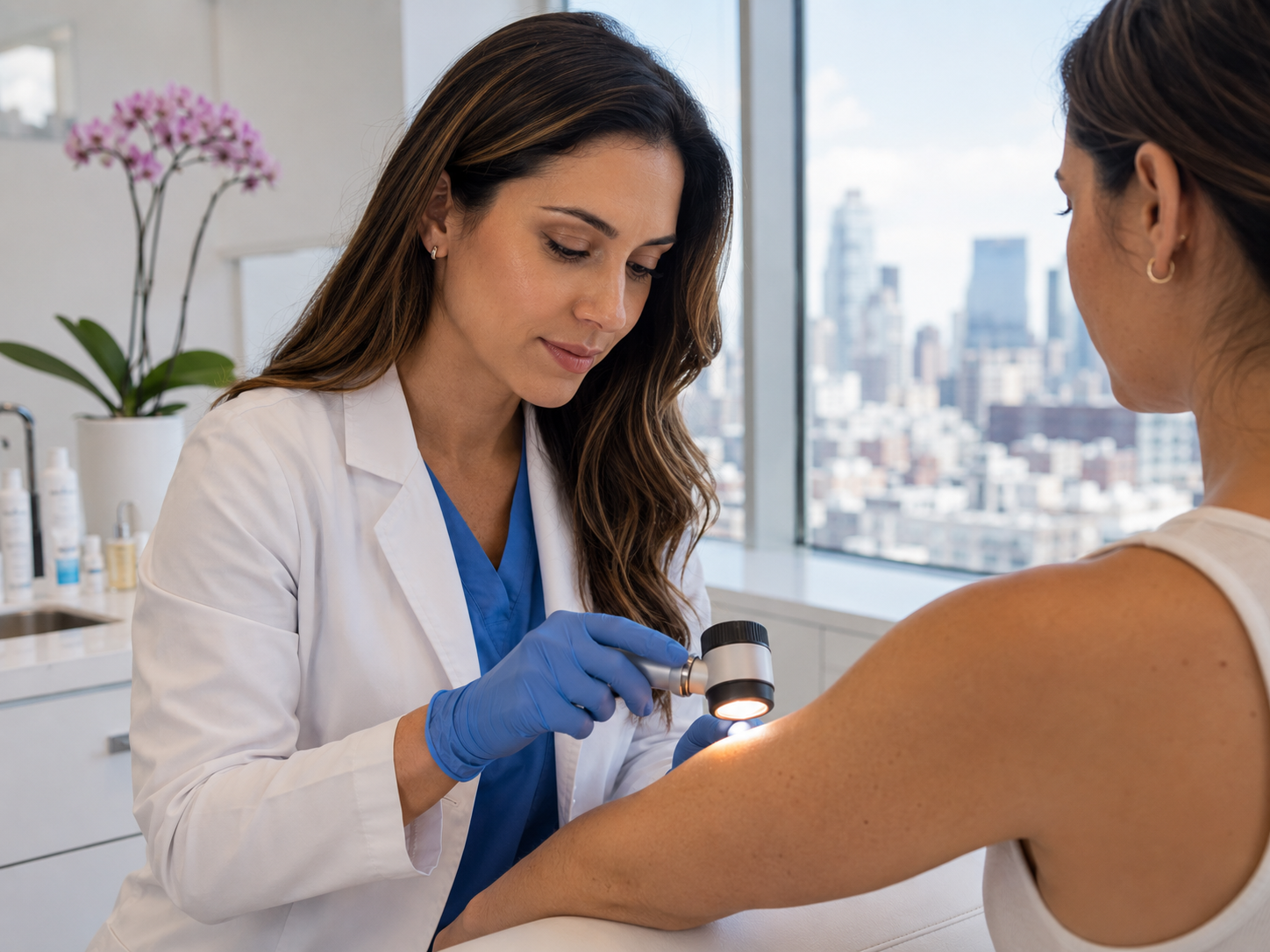


How often should an adult in the UK have their moles professionally checked? The honest answer is, it depends on you. Some people genuinely benefit from annual full-body mapping. Others only need a baseline check every two or three years. Most fall in between.
The variable that determines which group you're in is your baseline melanoma risk, and that risk is not a guess. It is the sum of five well-characterised factors that GMC-registered consultants use across the UK to decide who needs intensive surveillance and who does not.[1] Each factor is well-evidenced; together they place you cleanly in one of three risk tiers, each with a clear screening recommendation.
This guide walks through each factor in plain English, then summarises the three tiers and what they mean for your real-world habits. The point is not to alarm anyone, melanoma is uncommon and most adults sit in the lowest tier. The point is to make sure your screening cadence matches your actual risk, rather than the average.
Why baseline risk matters more than gut feeling
Most healthy adults' instinct about their own skin cancer risk is wrong. People with strong sun-exposure histories often underestimate their risk because they don't have any moles that look obviously alarming. People with a single dramatic-looking mole often overestimate their risk despite no other factors. Both groups end up booking the wrong frequency of professional checks.
What matters clinically is the weight of evidence across multiple factors, not any single mole or worry. The five factors below have been characterised in large epidemiological cohorts across decades. None alone is decisive; together they are accurate enough to drive a meaningful screening recommendation.
The structure for the rest of this guide is simple. Read through the five risk factors, decide whether each applies to you, count up your tier, then apply the tier-specific recommendation at the end. The whole assessment takes about ten minutes.
Factor 1: Family history of melanoma
A first-degree relative (parent, sibling, or child) with melanoma is one of the strongest single risk factors. Having one such relative roughly doubles your own lifetime melanoma risk; having two or more raises it further.[2] The risk scales with how many relatives are affected and at what age they were diagnosed (younger ages indicate stronger genetic loading).
Family history matters because melanoma has a meaningful inherited component. Some families carry mutations in genes like CDKN2A and CDK4 that directly raise melanoma risk; many more families carry less precisely characterised genetic factors that aggregate to a similar effect. Even without a known mutation, the pattern of multiple cases across generations is itself meaningful.
Score this factor as YES if you have at least one first-degree relative diagnosed with melanoma. Score it more strongly if you have two or more, or if any of those relatives were diagnosed before age 50. Second-degree relatives (aunts, uncles, grandparents) matter, but less.
Factor 2: Skin type (Fitzpatrick scale)
Fitzpatrick is the standard six-tier scale dermatologists use to describe skin's UV response. It runs from Type I (very fair, always burns, never tans) through Type VI (very dark, never burns, always tans). Types I and II carry the highest melanoma risk because their melanocytes have less natural protection against UV damage.[3]
Type I: pale white skin, often blue or green eyes, red or blond hair, freckles, burns easily, never tans. Type II: fair skin, often blue eyes, blond or light brown hair, burns easily, tans minimally. Type III: medium skin, any eye colour, brown hair, sometimes burns, tans gradually. Type IV: olive or light brown skin, dark hair, rarely burns, tans easily. Types V and VI: brown to dark brown or black skin, rarely or never burns.
Score this factor as YES if you are Fitzpatrick I or II. The risk gradient is real but it is not absolute, melanoma occurs in all skin types and is sometimes harder to spot in darker skin (acral melanoma on palms or soles is more common in Types V and VI). So this factor weights one way, but no skin type makes you exempt from screening.
Factor 3: Cumulative sun exposure
Sun exposure is the major modifiable melanoma risk factor, but its weight is more subtle than 'how much sun have you had recently'. Two specific patterns of exposure are particularly damaging: childhood sunburn (especially blistering sunburn under age 15) and intermittent intense exposure across adulthood (frequent tropical holidays, sunny weddings abroad, ski trips).[4]
Steady-state moderate exposure (a daily walk, gardening, working outdoors with reasonable protection) carries less melanoma risk than sporadic intense exposure, although it still matters for non-melanoma skin cancers. The mechanism is that intense exposure produces DNA damage faster than repair systems can keep up, while steady moderate exposure is better tolerated.
Score this factor as YES if any of the following apply: at least one episode of blistering sunburn before age 15, more than five lifetime episodes of severe sunburn, sun-exposed work (construction, sports coaching, gardening), or frequent tropical holidays without consistent SPF use. The closer you sit to several of these, the more weight this factor carries.
Factor 4: Mole count
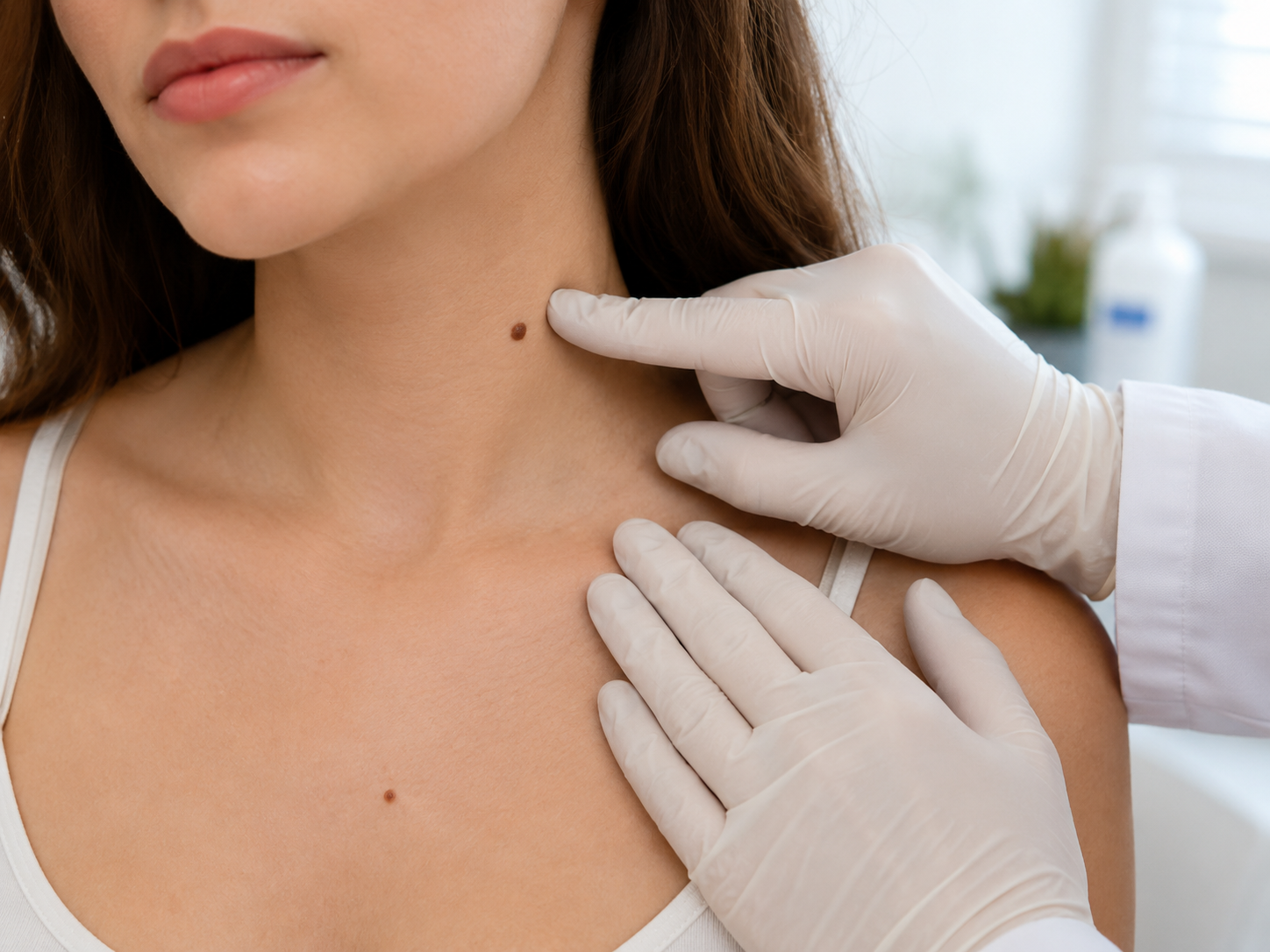
More moles, more chance for one to behave abnormally. The risk gradient is well-established: people with more than 50 moles have roughly double the melanoma risk of people with fewer than 25, and people with more than 100 are at higher risk again.[5] Atypical moles count more heavily than ordinary ones.
Counting moles roughly is easier than people expect. Stand in front of a mirror in good light, count moles on the front torso, back (use a partner or a phone camera), arms, and legs. You don't need to be precise; the question is whether you're closer to 'fewer than 25' or 'more than 50'.
Score this factor as YES if you have more than 50 moles, particularly if any are atypical (larger, irregular border, varied colour). The combination of high mole count plus visible atypia is meaningful and often warrants mole mapping rather than a standard mole check.
Factor 5: Personal history of skin cancer
If you have ever been diagnosed with melanoma, basal cell carcinoma or squamous cell carcinoma, your risk of a second skin cancer is substantially higher than the general population. The risk is highest in the first five years post-diagnosis and remains elevated for life.[6]
This factor is the strongest single predictor in the entire list, more weighty than family history or skin type. Patients with previous skin cancer should be in active surveillance regardless of how many other factors apply, and most UK guidelines recommend annual full-body checks at minimum, with mole mapping as the standard for melanoma survivors.
Score this factor as YES if you have ever had any form of skin cancer diagnosed and confirmed by histology. If you have, you should already be in regular dermatology follow-up, the rest of this guide is informational only; your screening cadence is set by your treating consultant.
Tier 1, lowest risk: zero or one factor
If you scored YES on zero or one of the five factors above, you sit in the lowest risk tier. The single factor most patients in this group score is skin type (many UK adults are Fitzpatrick I-II by virtue of demographics) or moderate childhood sun exposure.
Recommendation: a baseline mole check every 2 to 3 years is reasonable, both as a precaution and to establish a documented record of what is normal for your skin. Monthly self-examination using ABCDE, ideally with a partner's eye for the back and scalp. Daily SPF 30+ on exposed skin in summer; SPF 15-30 in winter.
Most adults in the UK fall into Tier 1, and most never develop melanoma. Tier 1 is not a license to ignore your skin, but it is a reassurance that intensive surveillance is not necessary for you.
Tier 2, moderate risk: two factors
If you scored YES on exactly two of the five factors, you sit in the moderate risk tier. Common combinations: fair skin plus childhood sunburn; fair skin plus family history; high mole count plus sun exposure.
Recommendation: an annual mole check with a GMC-registered consultant. Monthly ABCDE self-examination remains essential. SPF 30+ daily, SPF 50+ in summer or on holiday. Build a relationship with a single dermatologist or clinic so they can compare findings year on year, the value of professional checks compounds when the same consultant sees you repeatedly.
Tier 2 is the largest risk group and the one for which annual checks have the clearest evidence-based benefit. The annual rhythm catches both new lesions and subtle change in existing ones, and the £250 cost is meaningfully smaller than the cost of catching a melanoma late.
Tier 3, high risk: three or more factors, or any personal history
If you scored YES on three or more factors, or on personal history alone, you sit in the high risk tier. This includes patients with multiple atypical moles, melanoma family history plus fair skin plus significant sun exposure, and any prior skin cancer diagnosis.
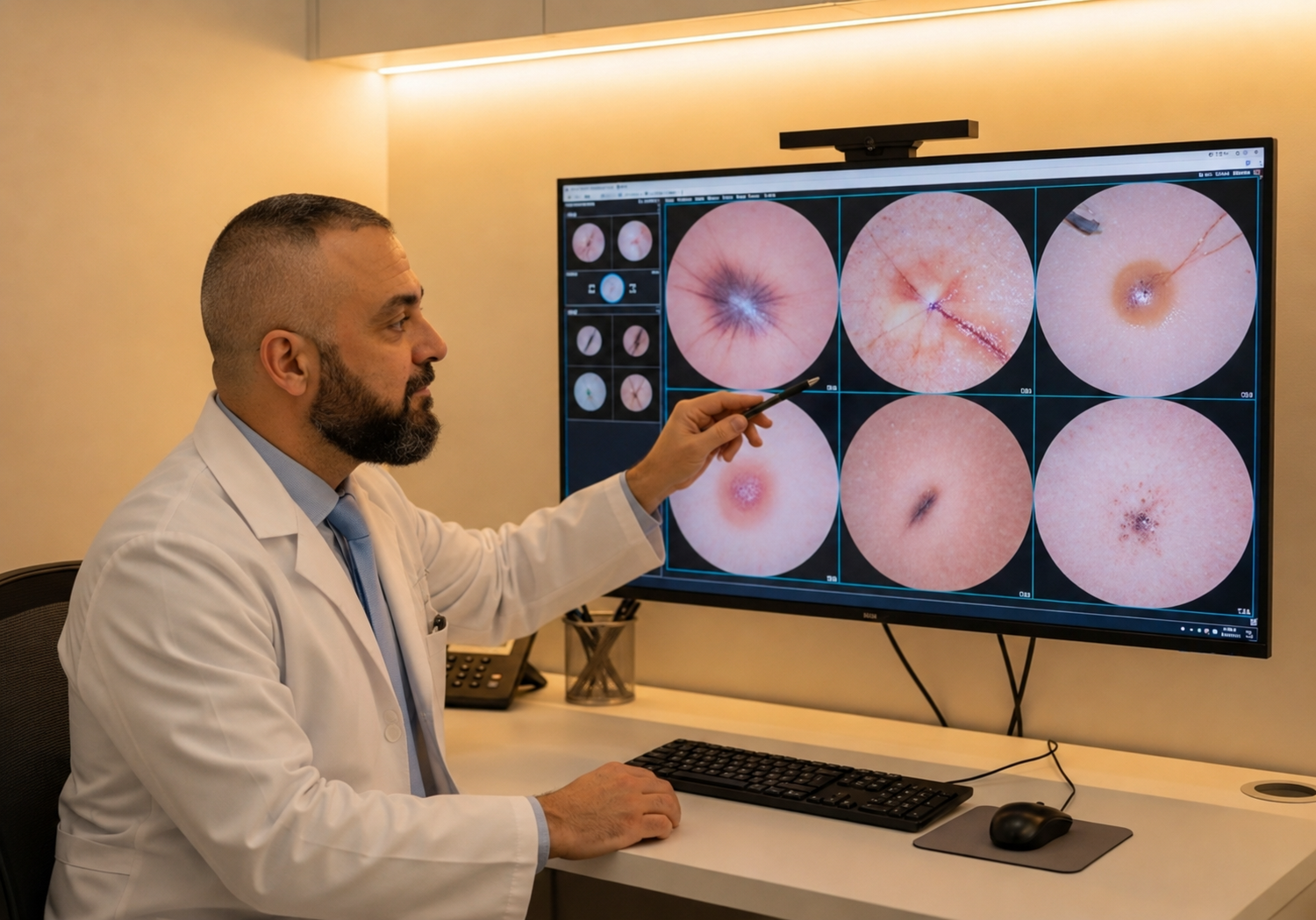
Recommendation: annual mole mapping, not just a standard mole check. Mapping uses standardised total-body photography plus dermatoscopic close-ups of every atypical mole, stored for side-by-side comparison year on year. The advantage compounds at every follow-up, subtle change becomes obvious in the gap between two images that wouldn't be obvious in either alone. For melanoma survivors and FAMM patients, six-monthly intervals are sometimes appropriate for the first one to two years.
Tier 3 is also where SPF habits matter most. SPF 30+ daily as a non-negotiable, SPF 50+ in summer, hat and shade in midday sun, and (ideally) a long-sleeve UPF-rated rash vest on holidays. Consider genetic counselling if you have multiple cases of melanoma in close relatives.
Common questions
Frequently asked
References
Sources cited
- Marsden JR, Newton-Bishop JA, Burrows L, et al. Revised UK guidelines for the management of cutaneous melanoma 2010. Br J Dermatol. 2010;163(2):238-256. View source
- Gandini S, Sera F, Cattaruzza MS, et al. Meta-analysis of risk factors for cutaneous melanoma: III. Family history, actinic damage and phenotypic factors. Eur J Cancer. 2005;41(14):2040-2059. View source
- Fitzpatrick TB. The validity and practicality of sun-reactive skin types I through VI. Arch Dermatol. 1988;124(6):869-871. View source
- Whiteman DC, Whiteman CA, Green AC. Childhood sun exposure as a risk factor for melanoma: a systematic review of epidemiologic studies. Cancer Causes Control. 2001;12(1):69-82. View source
- Gandini S, Sera F, Cattaruzza MS, et al. Meta-analysis of risk factors for cutaneous melanoma: I. Common and atypical naevi. Eur J Cancer. 2005;41(1):28-44. View source
- Bradford PT, Freedman DM, Goldstein AM, Tucker MA. Increased risk of second primary cancers after a diagnosis of melanoma. Arch Dermatol. 2010;146(3):265-272. View source